






Sven Tritschler has served as federal vice president of Alternative for Germany (AfD) since 2026. He has been a member of the North Rhine-Westphalia state parliament since 2017, where he serves as vice president of the parliamentary group and spokesperson for media, digital affairs, local government, and European affairs.
The AfD has swept the elections in Saxony-Anhalt and is just three points shy of an absolute majority. What happens now? Would you agree to govern in a coalition or with the support of the BSW?
Definitly – but not at any cost. The AfD is by far the largest party in the state parliament and our political imprint must be clearly visible. We promised a fundamental change of policy and e won’t betray that promise just for the sake of joining a government.. The AfD has nothing to fear from another election or a loser coalition of all the other parties. Chances are that both options would lead to an outright AfD majority next time.
What are the reasons behind the AfD’s meteoric rise?
Generally speaking: The failure of the old parties (CDU, SPD, Greens, FDP, Left). All of them have or had government responsibility in varying constellations and are therefore considered responsible for the weak economy, the migration crisis, skyrocketing energy prices, etc. People have learned that it doesn’t matter, which of the old parties they vote for, they get the same, failed politics. And Kanzler Friedrich Merz has become the symbol of this system.
Saxony-Anhalt in particular has always been one of our strongholds and our state-level party organisation has done excellent work: They closed ranks, ran a fantastic campaign with Ulrich Siegmund, an exceptionally strong candidate personally.
First we had the Grand Coalition, then the Traffic Light Coalition, and later the Multicolored Coalition. Now there’s already talk of the Coalition of Losers. How significant have these coalitions been in the decline of the traditional parties?
Germany was governed for decades by a cartel of three, later four parties. In our multi-level federal system, virtually every established party is in power somewhere… The system functioned as long as these parties covered a broad political spectrum from left to right. But the CDU has moved from center-right to center-left over the decades, especially under the leadership of Angela Merkel. A lot of people hoped that Friedrich Merz would lead a revival of the “real, conservative” CDU. Those hopes where deeply disappointed. Friedrich Merz is not a real conservative but a centrist an has to implement center-left policies, because he can only form a government with the Social Democrats, since the “Firewall” (“Brandmauer”) prevents him from forming a coalition with the AfD, even if he wanted.
In March of last year, Chancellor Merz linked the rise in violence against women to immigration, sparking a major scandal, although he now accuses you of seeking ethnic cleansing. However, many center-right parties are shifting their stance on immigration and forming governments with parties they not long ago labeled as extremist. Do you think that could happen in the CDU?
Such debates, which Merz sparked from time to time fueled the misconception, that he or his party are genuinely conservative or even somewhat “right wing”. But the voters have noticed that there are no real consequences: All talk, no action. In most of these cases Merz was even too weak to stand his ground in the public debate and walked back his more controversial positions or even apologized for them.
When he became Kanzler, he promised a fundamental shift in asylum policy (“Asylwende”). Nothing happened. The government and their friendly media outlets are announcing triumphal statements every few weeks, when the government charters a Boeing at taxpayers’ expense to deport 13 Afghan nationals to their homeland and forget to mention, that statistically around 70 Afghans enter Germany every day. But their propaganda doesn’t work anymore. People can see the results of this policy every day on the streets, in their neighborhoods, in schools.
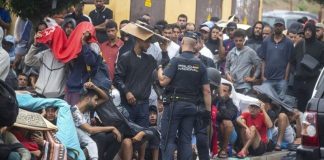
Speaking of remigration, what is your take on what happened in Ceuta and the Spanish government’s complete inaction?
It breaks my heart to see what is happening to Spain. Like many Germans, I have spent dozens of summer holidays in Spain. It was my father’s favorite place. And apart from its beautiful beaches, good food, and lovely weather I have always been interested in the country’s political situation and history. I can even see some parallels: Because of certain parts of our history, it was almost impossible for decades to establish a right-wing party. Luckily, that has changed and fortunately for Spain, the PP does not maintain a “Brandmauer”, so I had hoped for a center-right government.
That didn’t materialize. Instead you now have one of the craziest left-wing governments. Whenever the crazy lefties, Greens and feminists in our parliament have a crazy idea, they say “Spain is doing it”. Spanish politics has become a cautionary example and the invasion of Ceuta was the low point of this phase so far. I do hope that the Spanish people vote accordingly next time.
Pedro Sánchez’s government refuses to acknowledge Morocco’s role in using immigration as a weapon. Poland, Latvia, and Lithuania are experiencing this kind of hybrid warfare waged by Belarus, which is sending immigrants from the Middle East to Europe—many of whom are headed to Germany. How should Europe respond to hybrid warfare?
The answer to this “warfare”, as you call it, is obvious: 1. Protect the borders. 2. Don’t allow any irregular migrants to infiltrate the continent. Send them to safe, clean, and sanitary camps in a country that does not create an incentive for them to remain there permanently.. Like Australia has done. 3. If they bring children, educate them in their own language and provide them with skills that allow reintegration in their home countries. 4. Don’t give them cash that they can send home. Give them food and shelter. 5. Remigrate them as soon as possible.
If you do that consistently, there will soon be no people left that can be exploited as instruments of hybrid warfare. By the way: Germany is probably suffering the most from this situation. Our welfare state is far too generous with migrants and this pull factor is very powerfull.
You delivered humanitarian aid to Ukraine in 2022. Has that trip had an impact on you? What is your view on the Russian invasion of Ukraine?
Yes, I organized a small aid shipment together with several fellow MPs and party colleagues. Quite independently of where one stands on the conflict or how one views it, official assistance for the civilian population had not really got going yet, especially in the early stages. That was what mattered to us. The impressions reminded me very strongly of my time serving with the Bundeswehr as a peacekeeper in Bosnia and Herzegovina. That is where I learned what war can do to a country.
My personal view of the conflict is also the AfD’s position: this is a war of aggression launched by Russia in violation of international law, and it must be brought to an end as quickly as possible. When we visited in 2022, none of us could have imagined that the war would drag on for this long. By now, it resembles a drone-age version of the First World War: senseless slaughter for the sake of a few square metres of territorial gain.
Alongside the suffering of the people involved, as a German politician with a national outlook, I naturally also have Germany’s interests foremost in mind. From that perspective, I can only hope for peace. This war has caused enormous economic damage and continues to do so — including, and in particular, in Germany. I am no peace-at-any-price hippie, but this war is harming Ukrainians, Russians, Germans and the global economy. It has to end.
The AfD calls for peace, but there are many kinds of peace. A peace that rewards the aggressor—and there are far too many examples of this in history—only leads to an even greater war. What kind of peace does the AfD want?
I have to admit that, at least initially, I misjudged the Russian position to some extent. At the time, the German government and the Biden administration kept insisting: “We will only negotiate once the Russians have withdrawn from all Ukrainian territory.”
History teaches us that peace negotiations do not work that way. In the end, people sit around a map and draw lines — usually more or less where the front actually runs at that point. And yes, that is not always “fair”. As a German, I know very well how unjust the outcome of such negotiations can feel, especially when, as the weaker side, you are forced to accept the result.
Donald Trump had promised to end the conflict within a matter of hours. He did not quite manage that, but he has not given up, and he has also made it clear to the Ukrainians that US backing is not unlimited. At least from that side, there is now credible evidence of a willingness to negotiate. The Russian government, however, is not moving. That is where I currently see the main problem: the Russian establishment appears to have settled into the situation quite comfortably. In Moscow, you can still get pretty much anything you want — Western brands, smartphones, cars and the like — only through more indirect channels and at somewhat higher prices. For the rich and powerful, that is not a serious problem, and they do not have to send their own sons to the front either. Russia also has plenty of natural resources, so despite all the sanctions, I do not expect its economy to collapse.
Whether Ukraine’s strategy of now carrying the war into Russia will succeed is something I cannot judge. In any case, I fear that all of this could continue for a very long time, with all the unpleasant consequences that entails. I want a fair peace for Ukraine. I do not think that will be possible without territorial concessions. In return, Ukraine must receive firm guarantees that the resulting border will be permanent and inviolable.
Are you in favor of Germany’s rearmament?
Well, perhaps it is not so much a “rearmament” as a “rebuilding of capabilities” for our Bundeswehr, which has been badly neglected since the end of the Cold War. As a soldier, I experienced first-hand the at times disastrous condition of the equipment and barracks.
The AfD criticized this from the very beginning and called for greater investment and the reintroduction of compulsory military service, positions that remain part of our party program to this day. Defense capability and strong armed forces that are respected by society are traditionally right-wing positions, and the AfD is a right-wing party.
The current situation may have blurred that basic position somewhat. Unlike the Greens or the CDU, which for years neglected and underfunded our armed forces, we do not see their raison d’être primarily as serving as a force directed against Russia, but rather as a prerequisite and foundation for our sovereignty.
In addition, years of neglect of defense capabilities in Europe have created an enormous investment backlog, which everyone is now trying to make up for as quickly as possible and in a rather uncoordinated way. Money is being poured into expensive prestige projects, such as American fighter jets, even though in the kind of future warfare that is already becoming apparent in Ukraine, they may well prove significantly less useful than other investments.
Restoring our ability to defend ourselves, however, is a project that may take decades, and it will not be solved simply by spending as much taxpayers’ money as possible in as short a time as possible.
You defended AfD member Tim Schramm—who fought alongside the Ukrainian army and is a staunch supporter of Ukraine—against attempts to expel him from the party. Why did you do that? Could the clash between supporters of Russia and those who defend Ukraine lead to a split in the party?
I’ve known Tim since he was 18, and I was the one who brought him into the AfD back then. He had always wanted to become a soldier, but the Bundeswehr rejected him because he openly identified with the AfD — a national party. It is perhaps a peculiarly German situation that someone can be barred from serving in the armed forces because he loves his country too much.
I later took him with me to Ukraine, and at the time no one imagined that he might one day become a soldier there — least of all him. That developed gradually over the years, as his ties to Ukraine became closer and closer. Naturally, as a friend and as his employer, I strongly advised him against taking part in the war, because I was worried that he might never come back, or that he might return psychologically or physically broken. Fortunately, that did not happen, but the experience understandably had a profound impact on him.
While he was away, some people in the party tried to conspire against us to convince him to spy on my office. When that failed, the same people who had put him in touch with the press then tried to have him expelled from the party for speaking to the press. It’s ridiculous and the lowest anyone can sink in terms of character. The person primarily responsible for this operation has since had to find another job, but, unfortunately, not even in the AfD are you completely safe from people of dubious moral character.
Tim will remain in the party, and perhaps he simply needs to learn to keep his temper under better control. But I was much the same at his age. The attempt to expel him from the party was ridiculous from the outset and doomed to fail. German party law only allows that in extreme cases, and certainly not simply because someone holds a dissenting opinion and speaks about it publicly.
Since then, he has become something like the “Joan of Arc” of the pro-Ukraine camp within the AfD — a camp that is in fact more numerous than political opponents and the press like to portray. Of course, he represents an extreme position within the party, but so do the pro-Putin voices. Most members are simply German nationalists who do not want Germany to be drawn into foreign wars and would prefer good relations with both countries.
The fact that Greens and the Left walk around Germany claiming that Ukraine is fighting for “gender equality,” a multicultural society, and other so-called “EU values” naturally does little to generate sympathy for Ukraine on the political right. Of course, that is not true. Most Ukrainians I have had the chance to get to know would probably consider the AfD not right-wing enough. And Tim is, at the very least, doing a decent job of explaining that to our party colleagues.
How is the AfD preparing for the upcoming elections?
After 13 years, the AfD is still a young party compared with its competitors and remains engaged in an ongoing process of professionalization. With every election campaign, we learn more. At the same time, the political establishment is fighting us by every available means: the domestic intelligence service is monitoring us, our political foundation receives no public funding while the foundations affiliated with the other parties receive millions, and the state-funded public broadcaster — the most expensive in the world — conducts propaganda against us.
So we are fighting on many fronts, and yet we continue to grow stronger. This is especially true among the younger and middle generations, who fortunately have long since lost confidence in the established parties and their media. We will continue exactly as we have been, and I am convinced that at some point no one will be able to stop us.