






In June last year, I was fortunate to meet Professor Stefan Auer, holder of the Jean Monnet Chair at the University of Hong Kong and Dean of its School of Modern Languages and Cultures, when I was invited to a seminar in Madrid organized by the Royal University Institute for European Studies at San Pablo CEU University. Auer is about to publish a new book, Europe at War – The Fight for the EU’s Future, in which he analyses the consequences of the war in Ukraine for the future of the continent. Whilst awaiting the publication of Auer’s book, I have retrieved and updated an article I wrote at the time, but which was not published as it did not fit with the editorial line of the publication for which I usually wrote.
“Carl Schmitt in Brussels: the European Union, the Russian Ukrainian war and the return of geopolitics” – under this title, Auer put forward a series of observations on the controversial figure of Carl Schmitt and the continued relevance of some of the ideas of the German philosopher, whom Auer described as “a horrible human being, but brilliant as a theorist of war and international relations”. It is in this respect that Schmitt’s figure takes on significance today, particularly when his views are shared by figures such as Vladimir Putin.
In November 2022, Vladimir Putin met with the mothers of soldiers who had died in the misnamed Special Military Operation: “These young men did not die a useless death, like alcoholics, they died for the motherland. One day we will all leave this world, it is inevitable. The question is: how do we live? In some people it is not clear whether they live or not, why do they die, because of vodka? But their sons did live, they did not give up life for nothing. Do you understand? Their life was important.” These words make it clear just how highly the Russian president regards his compatriots; the Russians are a nation of alcoholics whose deaths as cannon fodder in the fields and cities of Ukraine serve a purpose – his own – and to fulfil that purpose, they may die in their hundreds of thousands. However, as Auer pointed out, this concept, the sacrifice of sons for the fatherland is deeply European and goes back to the times of ancient Rome, when Brutus is brought the bodies of his sons, who had to die because they had betrayed the Republic. Saving the distance from the Romans, Putin gives meaning to the life and death of the Russians on the battlefields of Ukraine.
“Nationalist and patriotic mobilization is very important, and, together with the economic incentive, it is working for Putin, which I regret because I am not a fan of Russia. But we have a problem in the West, in Europe, because while Putin embraces war as a crusade, a similar strategy is impossible for Europeans,” Auer pointed out, although a year on, economic incentives – let alone patriotism – are no longer enough to sustain Russian recruitment. But in the West, following decades of pacifism and the stigmatization of patriotism, most young Europeans are unwilling to take up arms. In Germany, which is now seeking to rearm and militarize, there are plans to recruit 30,000 soldiers a year (the number of Russian soldiers killed each month in Ukraine), but only 23 per cent of young Germans seem willing to defend their country. In fact, proposals to reinstate compulsory military service have been met with protests. The rest of Western Europe is not much better off and, apart from the Finns, no country exceeds 50 per cent.
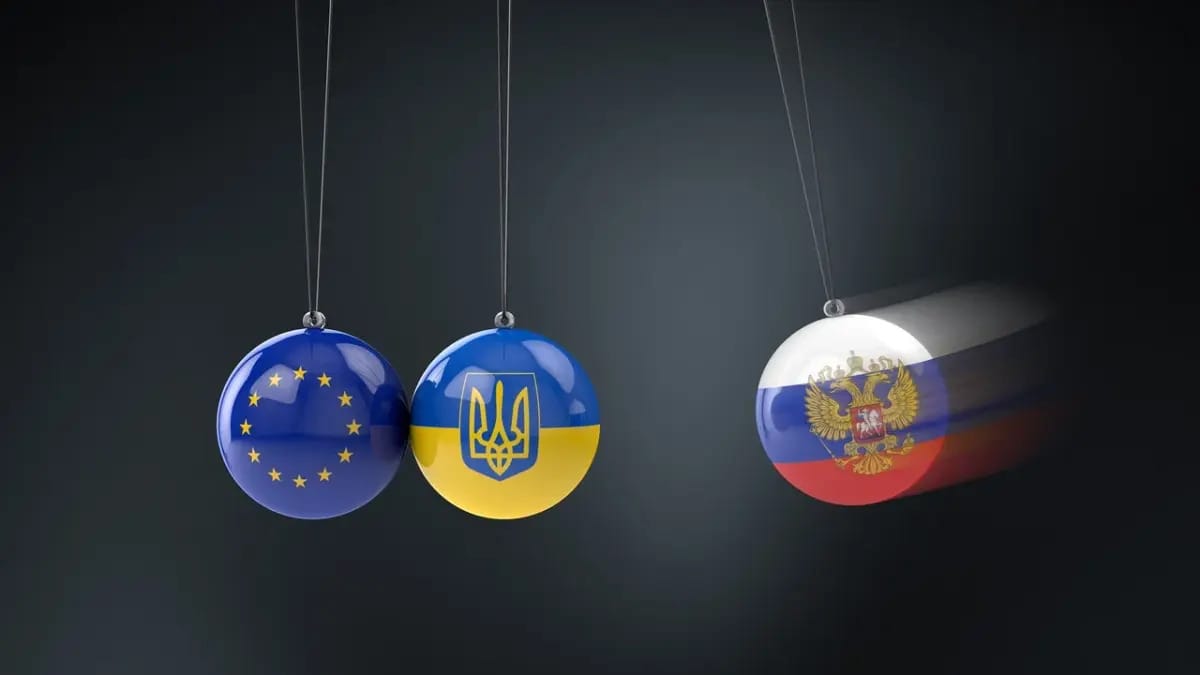
The major exception, of course, is the Ukrainians, who do possess a sense of national identity and a strong attachment to their culture, freedom and independence, and who, despite the most adverse circumstances, continue to resist both on the front line and behind the lines. The Ukrainians see their nation’s future within a European context, but the EU upholds a profoundly anti-national project and was not conceived to form a kind of state according to Schmitt’s concept. “However,” Auer pointed out, “politicians such as Josep Borrell or Ursula von der Leyen seem to be pushing in that direction. I am originally from the Czech Republic and am well aware that Russian imperialism must be stopped; the question is: can Borrell and von der Leyen stop Russian imperialism? No, because the EU is not a military alliance and cannot become one; what they have done is create false hopes, which is very dangerous in a war.”
“Putin lies when he calls the war a ‘special military operation,’ but, at the same time, European elites, as did the Biden administration, lie when they talk about ‘existential struggle for the West’ and fail to give Ukraine the weapons it needs to win the war. Many promises have been made, but actions have been lacking.” For Auer, it is the nation states and not a supranational entity, as the EU is now conceived by the Brussels elites, that can alone cope with a military threat because to do so they have a much more viable tool, NATO, created “to harness the powers of the participating nation states, rather than to build a new space in which sovereignty has no place; indeed, post-sovereignty politics cannot defend itself against an imperialist and aggressive country like Russia.”
At that point, the idea of a European army – stemming from the conception of the EU as a superstate – was raised once again, an idea which Auer considers absurd: “The EU cannot function as a security actor because there are deep divisions between member states on how to deal with Russia. Recall how in 2014, after the triumph of the pro-European revolution in Ukraine against the corrupt pro-Russian regime, we saw EU flags on the Maidan. Then came the annexation of Crimea and the conflict in eastern Ukraine. Two weeks before the start of the invasion in 2022, there were no EU flags in the Ukrainian parliament, there was the flag of NATO, the United States, Canada and countries that could help Ukraine against Russia, but there was no German or French, countries that at that time were to some extent aligned with Putin.” There is no European state, much less in Schmitt’s definition of a state, therefore, there cannot be a European army, and the EU cannot become a military actor: “Von der Leyen may practice the rhetoric of power, but she does not project that power.”
“We have to return to the politics of actions and abandon symbolic politics, and there is probably no politician in the West who does this (posturing) as often as Ursula von der Leyen,” Auer concluded. More than a year on, time has proved him right, and the words – the ‘deep concerns’ and the condemnations – have not been matched by the necessary actions. Some steps have been taken, yes, but they have generally been insufficient and slow. Too much time has been wasted whilst history, in all its harshness, unfolds before our very eyes. The new Cold War is a reality that cannot be denied, as Russia tests NATO’s response on our eastern border time and time again, with ever-greater audacity. Faced with the situation created by Donald Trump and his deal with Putin, Europe must develop the capacity to defend its borders without waiting for Uncle Sam’s cavalry. If we wish to play a role in the world, we must abandon experiments – be they ‘green’, ‘rainbow’ or ‘do-gooder’ – and empty rhetoric. Our lack of power projection is the consequence of having forgotten where we come from, particularly the ancient Roman maxim: Si vis pacem, para bellum. If you want peace, prepare for war. Europe has spent too long navel-gazing and will only be able to determine its own destiny if its nations and leaders – rather than its regulations and bureaucrats – become strong once more.