








Looking at what is happening in Germany, rather than simply celebrating AfD’s advance, we should be asking ourselves a very simple question: what would have happened in Italy if Giorgia Meloni had not succeeded in the far-from-inevitable task of building a right capable of channeling public discontent without becoming trapped by it, turning it first into electoral support and then into a governing force?
That is probably the question that best helps us understand Italy’s exceptional position within the European political landscape.
As we wrote when commenting on the German vote, dismissing what is happening as yet another warning about the so-called “black wave” means once again refusing to look at causes before effects. AfD is growing amid the crisis of a system that for years governed through grand coalitions, progressively narrowing the space for any real alternative, while an increasingly large share of the electorate developed a negative view of European policies, immigration, the green transition, declining competitiveness, and multiculturalism.
There are differences among Europe’s various right-wing parties, and in some cases they are profound, but that does not change the substance of the matter: the political demand they are responding to stems from real problems that certainly cannot be solved by demonizing them.
The difference is that Italy reached this turning point earlier and, above all, better prepared. Here, that political demand found a right with a history, a culture, a political class, and a community behind it. To truly understand Giorgia Meloni, this is where we need to start, while also avoiding the opposite mistake of portraying her leadership as though it had emerged out of nowhere.
Today’s Italian right owes a great deal to the journey that began thirty years ago with the birth of Alleanza Nazionale and the Fiuggi turning point, of which Pinuccio Tatarella was the principal political and strategic architect. It was Tatarella, known as the “Minister of Harmony,” who understood before many others that the Italian right had to leave political marginalization behind once and for all and become a governing force without severing its roots. Gianfranco Fini had the merit and courage to lead that transformation, together with a political class that included, among others, figures such as Ignazio La Russa and Alessio Butti, both of whom are pillars of Fratelli d’Italia today.
That was the essence of Alleanza Nazionale: transforming a political community that had remained on the margins of the system for decades into a modern national right, capable of speaking to a much broader section of Italian society and assuming the responsibilities of government. Today, that transition may seem almost natural, but in the political reality of the time it was anything but. It required courage, political skill and, above all, vision: understanding that remaining faithful to one’s history does not mean preserving it under glass, but making it capable of meeting the challenges of a new era.
Then came the Popolo della Libertà, the dissolution of Alleanza Nazionale, the rupture between Fini and Berlusconi, and finally the political collapse of a project into which much of the Italian right had converged. Enough has been written about those events, and there is no need to revisit them here. What matters is what happened afterward, when it would have been very easy to conclude that everything built up to that point should be discarded along with the mistakes that had led to that defeat.
Giorgia Meloni had the intelligence not to confuse the failure of one political season with the failure of an entire history. This is one of her greatest political achievements, and perhaps one of the least discussed: when she founded Fratelli d’Italia, she did not pretend to start again from year zero, nor did she make the mistake, so common in Italian politics, of tearing down everything that had come before in order to legitimize what came next. She preserved the best of Tatarella’s vision, the Fiuggi turning point and the experience of Alleanza Nazionale, together with the political, human and cultural legacy built by generations of activists, and carried it into a new political era.
In other words, she did not throw the baby out with the bathwater.
Doing so required foresight, but above all a particular sensitivity toward the community from which she came. Giorgia knows that community because she lived it. She knows the youth movement, the local party branches, the election campaigns, the defeats and the victories; above all, she knows the network of personal relationships that has always mattered at least as much as formal party structures within the Italian right.
This is what the left stubbornly continues to misunderstand and, fortunately for us, continues to pay a heavy political price for: the Italian right is not an electoral cartel cobbled together six months before an election by combining party labels, leaders and polling numbers. Before it is even a party, it is a human and political community.
It is a community that has existed for decades and has lived through the Msi, Alleanza Nazionale, the Pdl era and the birth of Fratelli d’Italia without ever truly ceasing to exist. It continued to live in local party branches, youth movements, local governments, associations, cultural battles and, above all, in the relationships among people who have often known one another for a lifetime. It is this intangible heritage that allows a political community to survive even when parties dissolve and symbols change.
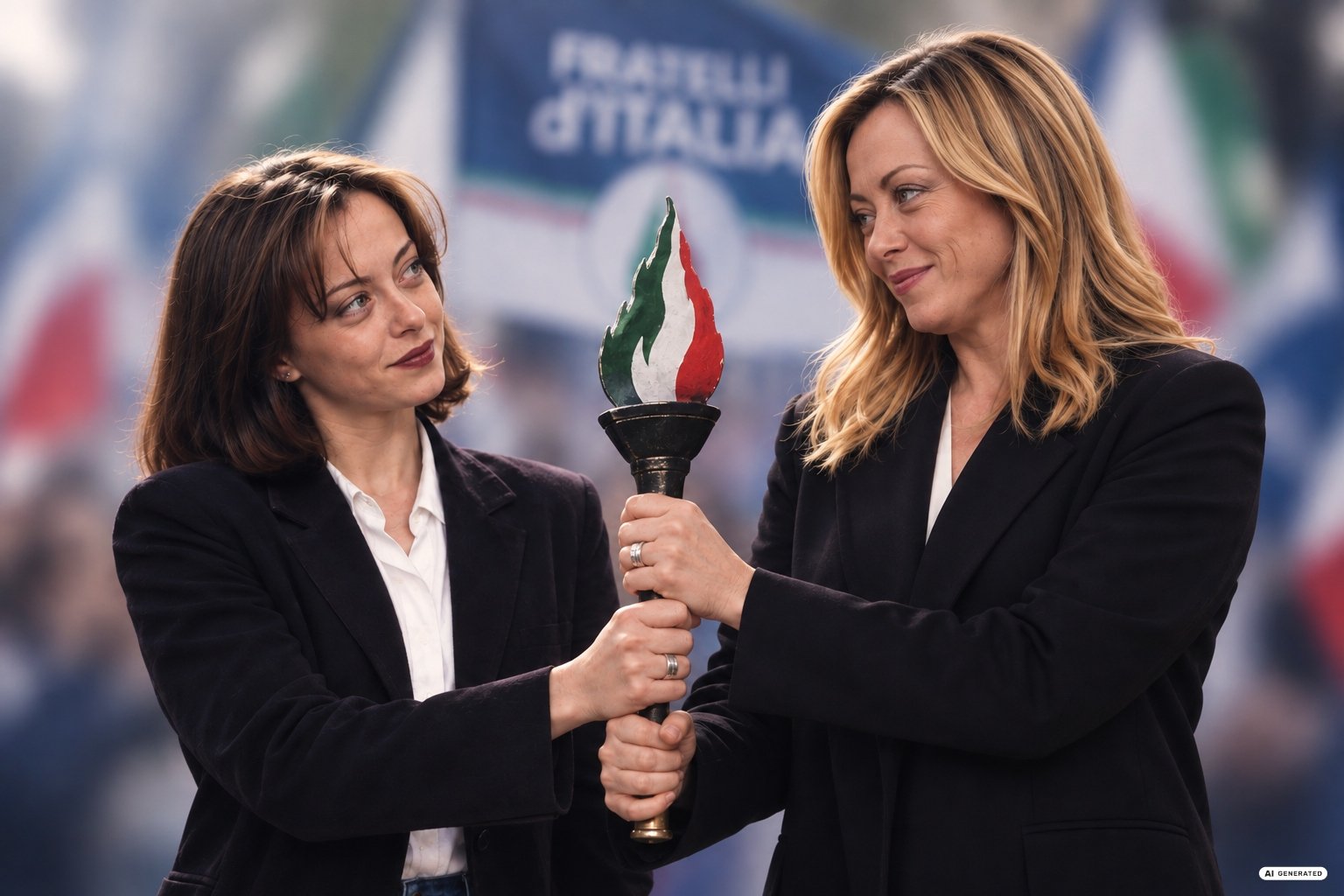
It is a torch passed from one generation to the next, and this is the key to understanding why the Italian right represents something unique in Europe today. A political phenomenon built solely on protest can rise rapidly and disappear just as quickly; a political community can lose elections, endure dramatic crises, choose the wrong leaders and even spend years on the margins, but it retains a collective memory from which it can rebuild. Giorgia Meloni deserves enormous credit for understanding that this torch did not have to be extinguished in order to artificially light another one: it had to be picked up and carried forward. And that is exactly what she did.
We can see the result today, while in several European nations the backlash against the disastrous ideological decisions that have dominated recent decades is still searching for a stable political form. In Italy, that demand found Fratelli d’Italia and a leadership capable of representing it without being relegated to the margins of the political system.
Above all, Meloni succeeded in the most difficult transition of all: making that right credible as a governing force without forcing it to be ashamed of being right-wing. She consolidated Italy’s place within the Western alliance, built international relationships, and earned an authority that is now acknowledged even by observers far removed from her political tradition, while continuing to speak about Nation, identity, family, security, borders, and the national interest.
She managed to broaden the right’s appeal without watering it down.
This is where the comparison with Germany becomes particularly interesting. In Italy, many of the concerns that elsewhere fuel anti-establishment forces have found representation within a right that governs and that possesses a recognizable leadership, an established political class and a political culture built over time. That is an enormous difference, because protesting and governing are two entirely different jobs. Channeling anger is relatively easy; turning it into a political project capable of leading a Nation is far more difficult.
Governing, of course, also means compromising, setting priorities, dealing with political constraints and making decisions that will not please everyone. A serious political community must never turn itself into a court, and supporting a leader does not mean abandoning critical judgment. But those who come from this history, perhaps more than anyone else, should understand the difference between disagreeing over a particular decision and judging an entire political trajectory. And that trajectory becomes even clearer when we look at what is happening around us.
Europe’s old political architecture is beginning to crack. The grand-coalition model can no longer contain dissent, multiculturalism has long shown deep fractures, immigration policy is dividing European societies, and green policies have imposed an economic and industrial cost that sooner or later will have to be discussed without ideological blinders. Continuing to answer all of this by shouting about the return of fascism whenever voters cast their ballots differently from what part of the establishment would prefer means continuing to misunderstand the age in which we live.
Italy, by contrast, already possesses something that many others are still searching for: a major popular, conservative, national, Western and governing right, supported by a community that was not born with the latest opinion poll and will not disappear with the next one.
That is why the responsibility today is even greater than it was in the past. Fratelli d’Italia must continue to grow, strengthen its roots and develop the political class that will one day have to take up that same torch. Because leaders, even the greatest ones, inevitably belong to a particular season; political communities endure across generations when they succeed in passing on values, memory, a sense of belonging and responsibility.
Almirante and Tatarella envisioned the transformation, Fini had the courage to lead it, a generation of political leaders and activists built it, and Giorgia Meloni, when that history seemed to have been broken, had the ability to preserve the best of it without denying its mistakes, taking it somewhere the Italian right had never reached before.
This is not a story that began in 2012, much less in 2022: it is a much longer story, made up of different generations that passed a torch from one to the next without ever allowing it to go out.
Giorgia Meloni received that torch, preserved it and carried it all the way to Palazzo Chigi. Looking at Germany and Europe today, we can therefore say it without reducing it to a slogan, and knowing exactly what it means: thank God for Giorgia.