











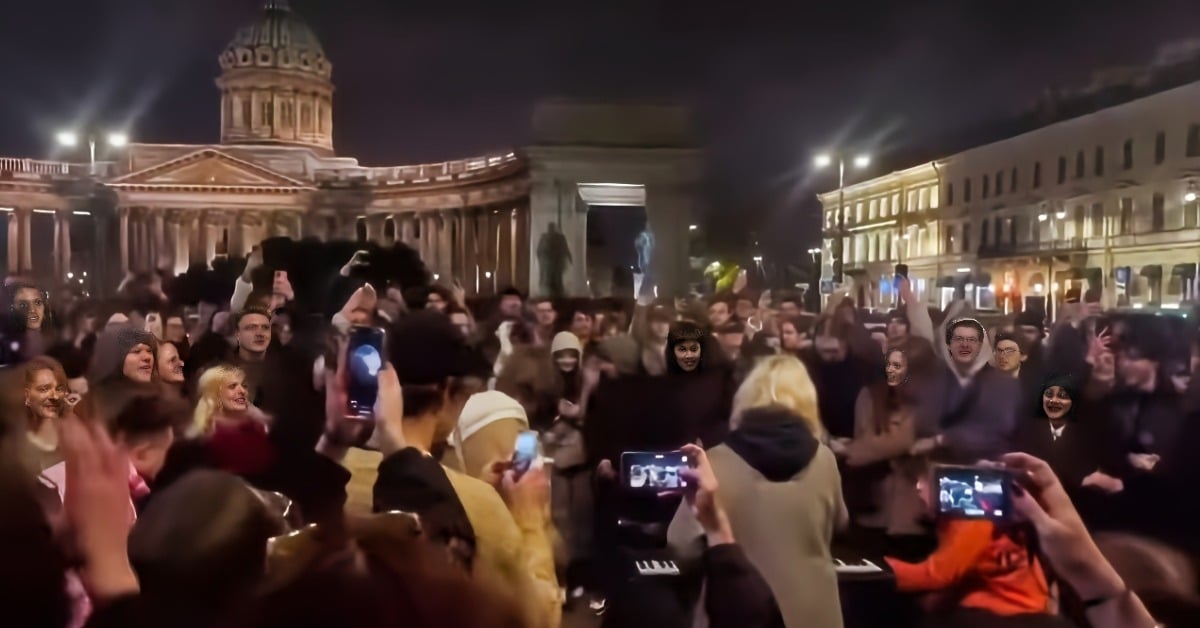
An improvised choir of hundreds of young people marched through the streets of Saint Petersburg singing Co-operative Swan Lake, the song by rapper Noize MC banned by Russian authorities for being considered an incitement to “subversion of the constitutional order.” This occurred Tuesday evening on Nevsky Prospekt, the beating heart of the city, in what appears to be the most unusual – and courageous – form of youth protest against Vladimir Putin’s regime.
Videos circulated on Telegram show a crowd of young people singing in unison the refrain: “Let the swans dance, let the grandfather tremble for his lake” – a clear ironic reference to Putin and his inner circle, owners of dachas on the shores of Cooperative Lake, from which the song takes its name. The images, filmed with smartphones, were confirmed by several independent Russian outlets such as Fontanka and iStories, as well as The Telegraph and RBC.
The protagonist of the episode is Diana “Naoko” Loginova, 18 years old, student and street singer. During her performance, the young woman attracted an increasingly large audience until she was stopped by police and taken away for “defamation of the army” and “organizing an unauthorized demonstration.” With her, also the members of her band, Stoptime, later released. No official denial came from the Kremlin, but pro-government Telegram channels reacted with anger, calling for exemplary punishments.
The Symbol of a Generation
For Russian Generation Z, Noize MC is much more than a rapper: he is a voice of freedom. His songs, banned from national platforms, are listened to through VPNs and shared clandestinely. Co-operative Swan Lake – already a symbol of dissent during the 2022 protests – has become a sort of unofficial anthem for those who refuse to bow to war and censorship.
According to Levada Center polls, fewer than one in four young people under 25 supports the “special operation” in Ukraine, while over 70 percent call for immediate peace. And despite the high rate of declared approval for Putin, only a minority of young people say they are convinced supporters of the president. The apparent youth consensus therefore hides a generation that is apathetic in public but restless in private.
62 percent of young Russians regularly use a VPN to access prohibited content, while almost half consider government censorship an obstacle to personal freedom. Telegram, Instagram and YouTube are their digital meeting places: spaces where protest transforms into music, memes and irony.
Since 2022, dozens of Russian artists have left the country or been labeled as “foreign agents”: among these, Noize MC, Monetochka, Zemfira, Oxxxymiron. Authorities have even sent lists of prohibited songs to karaoke bars in Saint Petersburg, in an attempt to erase every echo of dissent. But the music continues to circulate, underground.
“The homeland is not the president’s backside to lick, but the grandmother who sells potatoes at the station,” said Yuri Shevchuk, frontman of DDT, years ago. That phrase, taken up today by social media, has returned to resonate as a generational manifesto.
The image of young Russians singing a forbidden song in the heart of the night represents more than an act of courage: it is the metaphor of a generation that no longer wants to remain silent. Behind the notes of Co-operative Swan Lake there is not only anger, but a demand for dignity and truth. And if the regime can silence words, it cannot yet silence music.
In a country where even a guitar chord can become a crime, Generation Z has chosen to sing. Perhaps it is from there – from the song that resonates through the streets of Saint Petersburg – that the end of fear truly begins.