










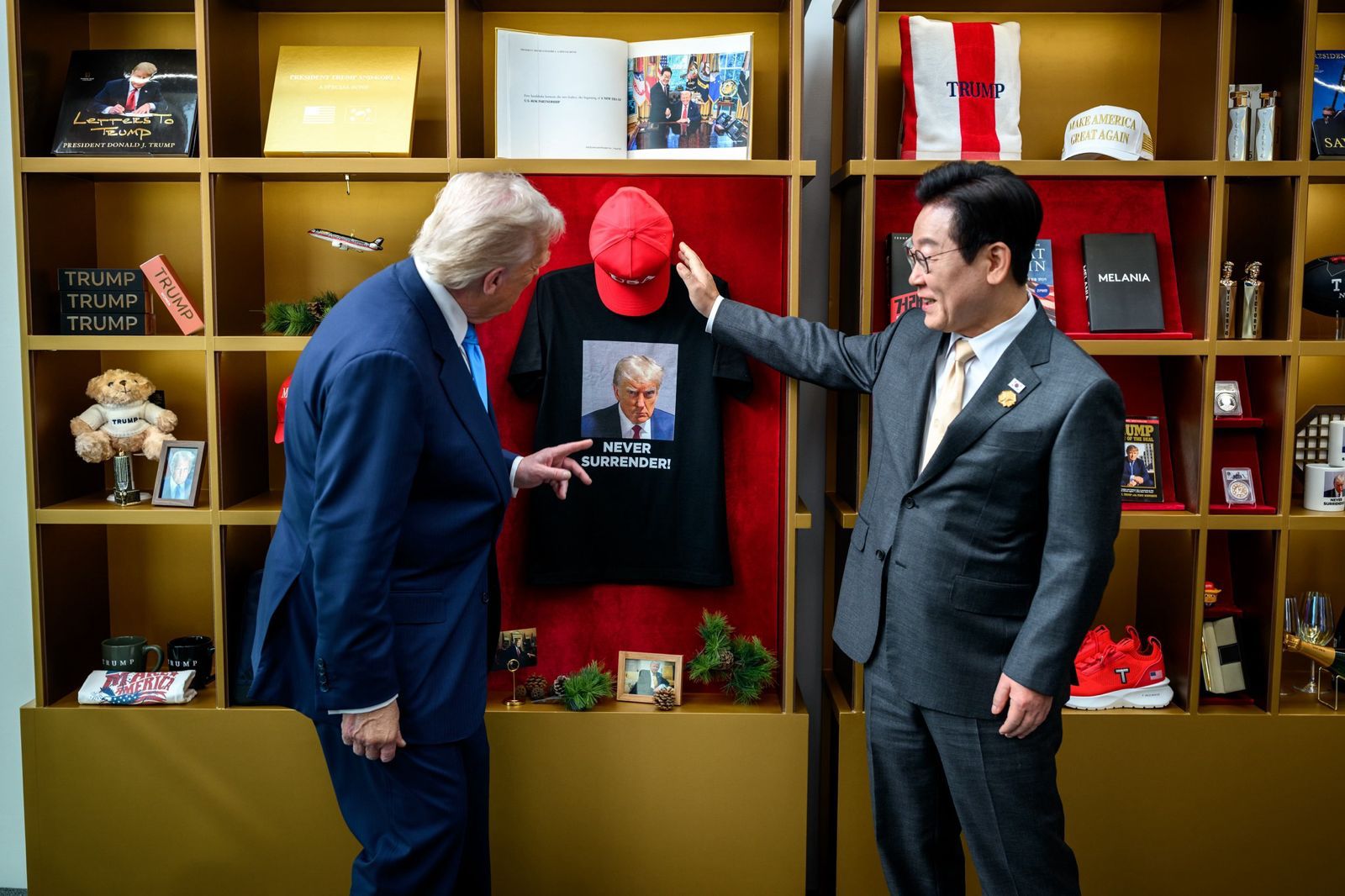
Let’s start in 2023, with what his enemies believed was the end – one of the roughly twenty-five hundred times they had declared him finished. It was August when the mugshot taken in Fulton County circled the globe. For days, the mainstream media, from CNN to The New York Times, passed the photo around like a trophy. It was supposed to be the image of defeat, the symbol of a man isolated, broken, reduced to a legal case. In reality, it was the exact opposite. In that steady, unflinching gaze there was no surrender – only the awareness of someone who had already won on the level of history, long before doing so in politics.
“Never Surrender,” he wrote on X a few hours later, and that phrase, more than a message, became the synthesis of nine years of persecution, trials, lies, and attempts to erase him. Within days, that photo had transformed Trump into the face of resistance against the established power. While the media and judicial system tried to destroy him, millions of Americans – many who had never voted for him – began to see in Trump not just a leader, but a man being crushed by a repressive machine that tolerated no dissent.
It was yet another demonstration of how little the media understood Trump – and, more broadly, real America. The same columnists who for years had covered up the lies of Biden and then of Kamala Harris, defending the toxic narrative of a “recovering nation” while families struggled to fill their refrigerators, didn’t realize that their arrogance was fueling the silent revolt that would carry Trump back to the White House.
That’s where a campaign began that will go down in history. No script, no choreography, only reality. A campaign lived mile by mile, rally by rally, with Trump traveling among the people while his opponents hid behind the walls of Washington or the sterile sets of television studios. It was a campaign that demolished the very concept of a “controlled narrative,” overturning the global media order.
2023 was the year the final break occurred between truth and traditional information. The TV networks and newspapers that for decades had imposed their version of reality – the same outlets that had idolized Obama, protected Biden, and then tried to crown Kamala Harris – kept repeating that “Trump is finished.” Every poll showed him losing, every commentator called him a relic of the past, every talk show portrayed him as a threat to democracy. Meanwhile, in the real country, the opposite was happening. Millions of people, tired of being deceived, began to believe again.
With Elon Musk’s purchase of Twitter and the birth of X, Americans got back what had been denied them for years: freedom of speech. Trump immediately understood that the platform was the key to bypassing the censorship of the mainstream media and speaking directly to the nation. Within months, his voice became unstoppable. The alliance between Musk and Trump – between technology and real politics – marked the birth of a new space for freedom, and with it, a new era. While CNN and MSNBC filled their panels with “experts” explaining why his candidacy was impossible, X’s audience numbers were surpassing those of all the major networks combined. It was the tangible proof of what I had written in Trump Segreto: mediated information is dead, and the people have chosen to inform themselves.
Then came the summer of 2024 – and with it, the toughest test. On July 13 in Butler, Pennsylvania, during a rally, a sniper opened fire. A bullet grazed the President’s head. In a few seconds, the crowd went from panic to silence, then to a single roar – the collective awareness of being part of something greater. Trump, blood streaming down his face and his fist raised, shouted three words: “Fight, fight, fight!” That moment marked a point of no return. Because in that image, broadcast live to millions, there wasn’t just the resistance of one man – there was the survival of the very idea of freedom.
No consultant, no speechwriter, no stage director could have crafted a symbol that powerful. It was the instant Trump stopped being merely a political leader and became the moral reference point for an entire people. From that day forward, nothing was the same. The attempted attack foiled weeks later in Florida confirmed that his race was more than a political campaign – it was a battle between truth and the system.
At the Republican National Convention in Milwaukee, the atmosphere was that of great historical turning points. Hulk Hogan delivered a goosebump-raising monologue in his honor, his running mate JD Vance moved the audience to tears as he spoke to his mother – whom he had helped overcome addiction – and Trump entered between two roaring waves of people, as if the whole nation had decided to escort him symbolically to the White House. Then came Elon Musk and Robert F. Kennedy Jr. beside him – the first, the emblem of free innovation; the second, heir to a Democratic dynasty that had chosen to break ranks and stand with the people. Kennedy spoke just a few words, but they were decisive: “This is no longer about right or left. It’s about freedom versus control.”
That was when the Patriot Front took shape. No longer a political movement, but a cultural and moral community uniting Midwest farmers and California entrepreneurs, veterans and young programmers, Catholics, Jews, and independents – all bound by a simple, powerful idea: America belongs to Americans.
And yet, while all this was happening, the mainstream media kept pretending not to see. CNN aired Kamala Harris’s press conferences live, calling her “the candidate of hope,” while ignoring Trump’s overflowing rallies. The New York Times ran outraged editorials about the “authoritarian threat,” even as millions on social media told stories of lives devastated by Biden’s failures. MSNBC opened its evening news talking about “Trumpian conspiracies,” but by then, everyone could see that the real conspiracy was a media system serving power.
Trump answered with deeds, not words. He visited factories, police stations, and military hospitals. He stopped in fast-food joints, stores, and shopping centers, talking to anyone who wanted to be heard. One day in an Ohio McDonald’s became legendary: “Pay for everyone – on the President,” he said with a grin, as the crowd burst into applause. A simple scene, yet more revealing than any speech – proof of the immense distance between him and the scripted politicians of Washington. America recognized in him not a man pretending to understand them, but one who lived as they did.
Then came November 5. That night, the TV networks tried to resist the evidence, stretching their analysis while key states fell one by one. Pennsylvania, Georgia, Michigan, Arizona – all orange. By 3:47 a.m., the map was clear. Donald J. Trump was once again President of the United States. No theatrical celebrations, no triumphalism – just the quiet certainty of a man who had walked through hell and come out the other side.
A year later, that mugshot hangs outside his office in the White House. Not as a trophy, but as a warning. Every day, millions of Americans see it and remember that freedom has a price. The economy is booming, inflation is under control, borders are secure, jobs are growing, and the word “Patriot” has returned to the political lexicon without shame.
And beside Trump stands Giorgia Meloni – the first European leader to grasp that the future of the West depends not on erasing identity, but on defending it. Together, they embody the most solid response to the globalism that sought to weaken peoples and dissolve nations.
This is no longer just about American politics. It’s about the West – its moral, cultural, and spiritual survival. Trump’s victory on November 5, 2024, was not a simple alternation of power; it was the beginning of a new historical phase. It proved that one can prevail against everything and everyone – if one has the courage to remain faithful to who they are.
Today, November 5, 2025, as we look at that photo hanging in the White House, we can say that “Never Surrender” was never just a campaign slogan. It was a prophecy. And it came true.
Relive Trump’s epic presidential campaign with our special report: