








By Javier Benegas
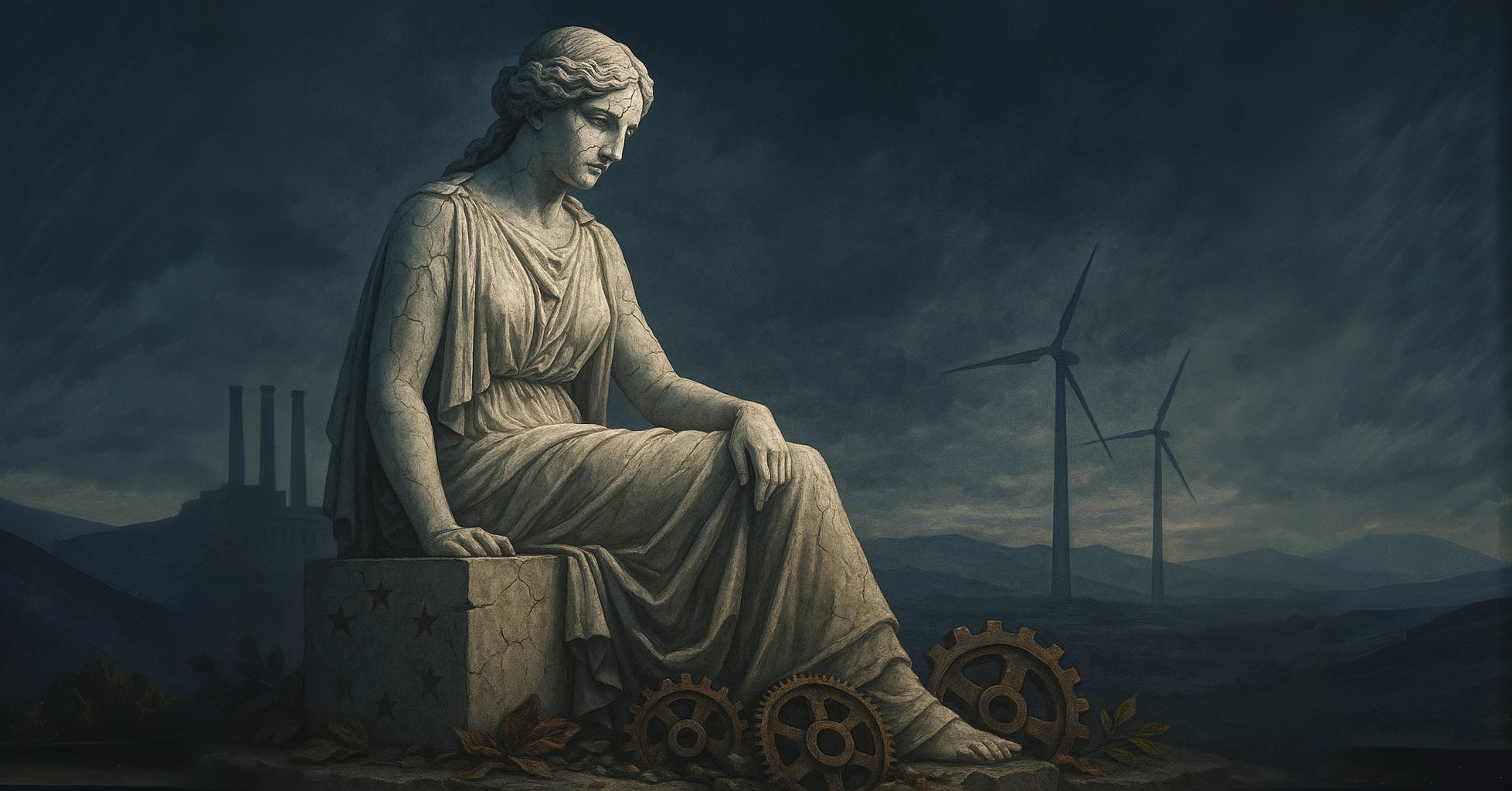
At first glance, it might seem that Europe is going through a natural cycle of decadence: the predictable decline of an old civilization, exhausted by its own success. But that explanation is too simple and incompatible with the political developments of recent decades. What we are seeing is not a natural process, but a managed collapse, the product of political decisions and particular interests wrapped in a great moral fraud.
Europe has not collapsed because of an excess of virtue, but because virtue has been manipulated. The common good was invoked to justify disastrous policies, the salvation of the planet was proclaimed while industry was destroyed, solidarity was preached to cover up social bankruptcy. The appearance was moral; the intention, vilely material.
History is not written by the forces of determinism. It is people who decide where to look and move forward. For decades, European leaders have looked where it suited third parties and, of course, themselves. That is why the question, more than rhetorical, is an appeal to the responsibility of the European leaders and to a good part of the society that has been an accomplice: what have you done with Europe?
The “green” trap
It all began when Europe exchanged fire, which the Greek titan Prometheus stole from the gods to give to mankind, for the fanaticism of zero carbon. Before launching the energy transition, the European Union accounted for about 7% of global greenhouse gas emissions; after decades of “green” policies and hundreds of billions of euros – who knows if billions – this percentage, already marginal in origin, was barely reduced to 6.8% (data for 2022).
That pathetic reduction, as I say, cost hundreds of billions of euros, the loss of millions of jobs and a crazy structural increase in the price of energy that today suffocates households and businesses. In Germany, Europe’s most industrialized country, manufacturing output has fallen by around 25% since 2018, according to Bundesbank data, as a result of green policies.
Economist Bjorn Lomborg described it with irony: “Europe could disappear tomorrow and climate change would barely bat an eye.” However, the Old Continent embarked on an ecological crusade that has benefited precisely those who have ignored it. Thus, while Europe was committing energy suicide, China and India were opening more and more thermal power plants.
The energy transition quickly became a political religion, an unquestionable dogma of faith, on pain of being burned at the stake with a sign around your neck reading “denialist”. Indispensable industrial progress was replaced by environmental fanaticism; entrepreneurship by atonement. In the name of the planet, nuclear power plants were dismantled, inefficient technologies were subsidized and the combustion engine, the backbone of the European automotive industry, was criminalized.
The result: a continent a couple of tenths less polluting, but alarmingly less competitive, less free and more dependent on its enemies. Europe did not save the planet; it saturated it with “green energy” manufactured in polluting China.
The myth of immigration as a savior
The other great deception was social. Faced with unstoppable demographic aging, European governments presented massive immigration, including irregular immigration, as a miraculous solution: to rejuvenate the continent, supply the missing labor force, ensure pensions and sustain the welfare state. But the reality has been much more complex and radically opposite to the promise.
The Scandinavian countries, traditionally open and tolerant, have been the first to reach an uncomfortable conclusion: immigration only works if the newcomer accepts the principles of the receiving country, has the necessary qualifications to integrate into its economy and become a net contributor.
Finland was the first European country to recognize in 2022 the reality that “the fiscal balance of non-Western immigrants is negative”. In Sweden, around the same time, the then Prime Minister Stefan Löfven openly spoke of an “integration crisis” and of neighborhoods that had become Comanche territory where the police could not venture unless accompanied by the army. The statistics, far from denying it, confirm it: in Stockholm, Malmö or Copenhagen, the crime rate linked to immigrant communities far exceeds the national average. Three out of four homicides are committed by immigrants and, in rape cases where the victim did not know the assailant, more than 80% of those convicted were born outside Europe.
The problem is not immigration per se, but its typology and incentives. Europe does not attract those who want to prosper through hard work, but those who are seduced by the welfare state’s generous catalog of social benefits. This combination of low skills and high public spending has turned mass immigration into a factor of structural imbalance.
The contrast of current immigration with the history of immigration in the West is quite eloquent. The immigration that strengthened and turned the United States into a rich and dynamic nation or that brought thousands of Spaniards to France, Germany and Switzerland in the 1950s was essentially entrepreneurial immigration: they worked to move up, not to support themselves. Today, the opposite is true: many immigrants settle in Europe not to prosper through their own initiative, but to be supported. After all, that is what we are selling: Social state for all.
In addition to this structural cost that threatens the sustainability of the welfare state, there is an even more destabilizing phenomenon: culture shock. An important part of the migratory flows comes from Muslim countries where religion regulates social, political and family life. In more and more suburbs, neighborhoods and urban areas in Europe, the authority of the imam outweighs civil law. Former French Prime Minister Manuel Valls summed it up in a phrase: “There are territories where the Republic no longer has the last word.”
The real threat is not economic or demographic, it is civilizational. The problem is not that some are gradually replacing others, but the progressive replacement of a model based on freedom, equality and non-discrimination that took centuries to establish by another completely antagonistic one that takes us back to the past. Thus, what politicians sold as diversity has turned into fragmentation; what was supposed to revitalize the welfare state and the rule of law is undermining it. Europe, as a land of freedom, prosperity and justice, is not evolving: it is disintegrating.
Merkel, the Greens and the demolition machine
There are names in the European drama, and none more symbolic than that of Angela Merkel. During her sixteen years as Federal Chancellor, Germany – and dragged along by her a good part of the continent – embraced a lethal combination of green moralism and political calculation.
After the Fukushima accident in 2011, Merkel ordered Germany’s nuclear power plants shut down, even though none posed a real risk. A decade later, Germany was more than 55% dependent on Russian gas and 40% on imported coal. In the name of sustainability imposed by Merkel and her partners, Europe’s leading power became dependent on the Kremlin.
But her legacy did not stop there. In 2015, Merkel opened Germany’s doors to more than a million migrants, mostly from Syria, Afghanistan and North Africa. She presented it as a moral gesture – “Wir schaffen das” (“We can make it”) – and was applauded as an example of European hospitality. In reality, it was a response to an economic emergency: the labor shortage that had been weighing down the German economy for decades.
That improvised policy transformed demographics and strained the European consensus. For years the subject was treated as a taboo, but reality eventually prevailed. Today it is even social democratic governments that have tightened migration control, admitting what until yesterday was forbidden: that integration is not automatic, that multiculturalism has costs and that unconditional hospitality has serious consequences.
Merkel, true to her style, wrapped it all up in an edifying narrative: Europe in solidarity in the face of a cruel world. But beneath that virtuous veneer lay, of course, short-term calculations and a dangerous naiveté about cultural assimilation.
Merkel did not act alone. The traditionally minority Green parties became a force in government almost overnight. Their influence was not limited to Parliament, but spread like a virus far beyond: foundations, NGOs and “environmental” lobbies colonized Brussels and Berlin with generous budgets and opaque financial sources. The French think tank IDDRI, for example, one of the most influential in European climate policies, has members linked to the Chinese Communist Party on its board.
Meanwhile, without anyone daring to raise their voice, the Energiewende – the German “energy transition” – became the model for the entire Union. The price of industrial electricity doubled; so did the price of housing. Companies began to vote with their feet: BASF moved the bulk of its production to China, Volkswagen to the United States, Siemens to Asia. The president of the Federation of German Industry (BDI) summed it up with icy laconicism: “We are experiencing a silent deindustrialization”.
With hindsight, there is no doubt that the alliance between Christian Democrats and Greens was the perfect Trojan horse. Environmental moralism, which gave so much play in the election campaigns, concealed an unprecedented industrial dismantling. And environmentalism, erected as a guiding principle of politics, left Europe unable to compete and at the feet of its global adversaries.
External interference, internal corruption
Internal disarmament coincided in a suspiciously synchronous way with an external phenomenon: the energy and technological pincer. On the one hand, dependence on Russia; on the other, dependence on China.
For years, Moscow supplied Europe with cheap gas. Nord Stream I and II sealed the dependence as a colossal intravenous line. When the Ukrainian war broke out, that dependence was revealed as a death trap. Suddenly, morally superior Europe had to beg for energy from regimes it hypocritically despised in public while funding in private.
At the same time that Europe was becoming energetically dependent on Russia, it was handing over its industrial and technological future to China. Today, more than 95% of the rare earths needed by European industry come from the Asian giant; the same goes for magnesium, lithium and the essential components of solar panels and batteries. The European Union boasts of green leadership, but the heart of its energy transition beats in Chinese coal-fired factories, to the rhythm of the CCP’s pacemaker.
None of this is the result of chance. It cannot be. Not even European politicians can be that stupid. While Europe was dismantling its industry, Beijing was investing billions in fossil energy and exporting the “clean” part of the equation. European climate policy has not held China back: it has financed it. It has turned the communist regime led by the megalomaniac Xi Jinping into a dragon ready to swallow Europe and the West in one bite. As the Financial Times sarcastically denounced: “Europe is not getting greener, just more dependent on the polluter”.
For decades, European leaders have been giving us a pig in a poke: material subordination as moral autonomy. No invasion or outright conquest has been necessary. Compared to the enormous resources that would have been necessary to carry out a conventional invasion, a modest amount of money has been enough to buy wills and finance the propaganda of false European virtue to win the “war”.
Get up and walk
Europe has not reached this desperate situation by accident. The alliance of ideological, political, bureaucratic and financial interests has transformed the rhetoric of European virtue and moral superiority into an extremely profitable business, to the benefit of a select minority and to the detriment of the vast majority. Under the banner of sustainability and solidarity, a monstrous web of power has been woven, distributing hundreds of billions of euros in funds, business, positions and favors while the real economy crumbles. The result is an increasingly aging, deindustrialized and culturally fractured continent, all while its leaders proclaim a non-existent moral superiority.
The future, however, is unwritten. Nothing is known about tomorrow. History, which is very long, teaches us that societies can be reborn if they regain their self-awareness. Europe still has the resources, the knowledge, the tradition and the memory to do so. It only needs to recover from this induced amnesia and remember what it was and what it still is: a project of freedom, creativity and responsibility, not of dependence or guilt.
“The price of liberty is eternal vigilance,” warned Thomas Jefferson. Europe, which knew how to project the principle “all men are equal before God” into that of equality before the law and equality of opportunity, which gave birth to Christianity, the Enlightenment and modern freedom, has ceased to watch… and to believe.
Repairing the damage and making up for lost time is still possible, but it will require a rebellion against ideological imposture and, above all, against corruption and the buying of wills. What is at stake is not only the future of a continent, but the dignity of a civilization that allowed its virtue, the true one, to be turned into a masquerade. Europe is not yet condemned; only deceived. And like all deception, once revealed, it can be reversed.