











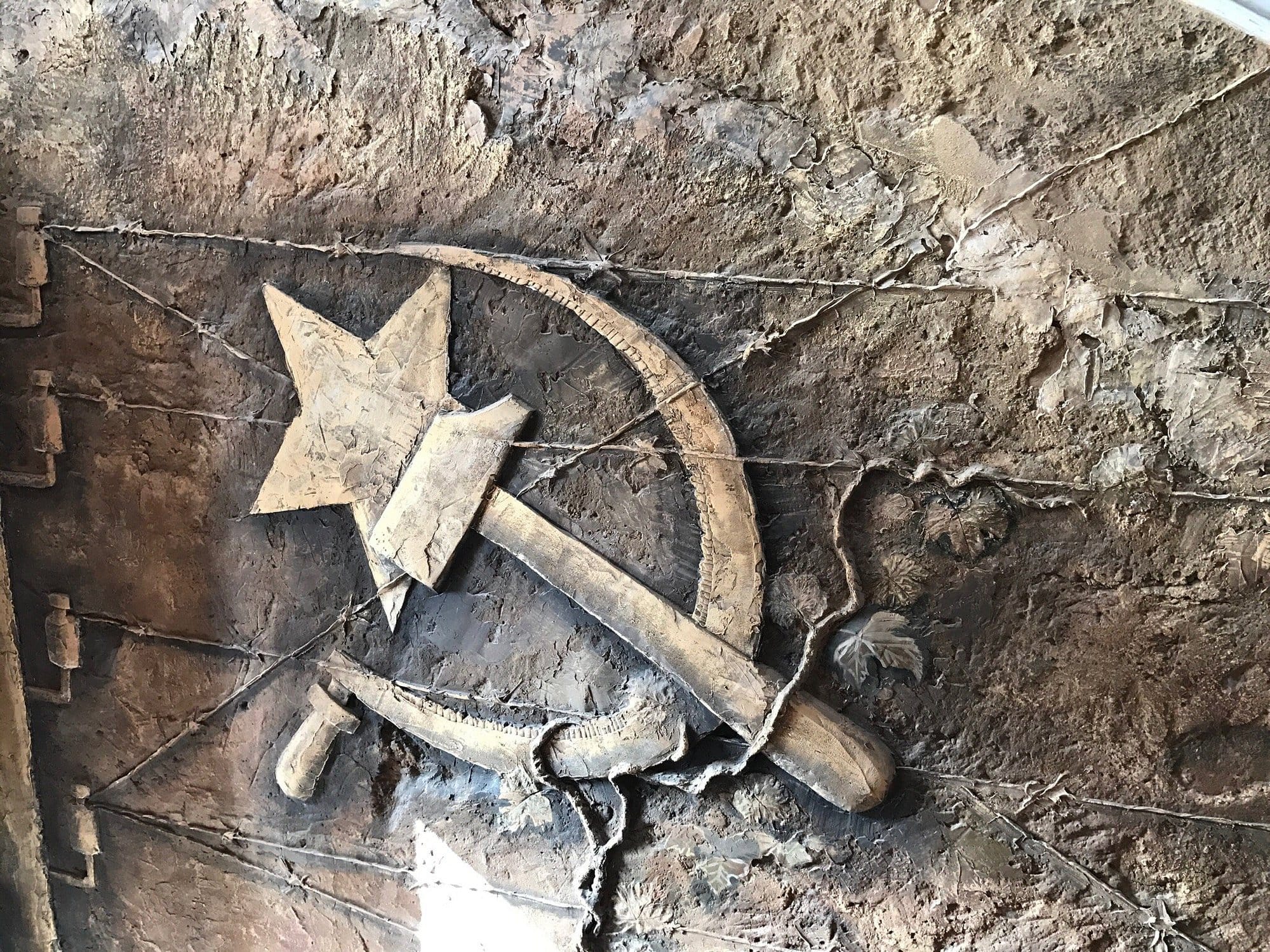
In July I was in Moldova, a not too frequented destination, to attend a series of conferences of the MEGA event in its capital, Chisinau, and I had a few hours to walk around the city. Most of the monuments and museums are in the center, a little more than fifteen minutes away from each other, so I was able to do a fairly complete tour and see elements of the recent Soviet past in some government buildings, such as the sickles and hammers that still decorate the Ministry of Justice.
After a nice walk, I went to the military museum of Moldova, a building in which we can see Dacians, Roman legionaries, Christian knights, Ottomans, Russians, Romanians, Germans and Soviets, up to the war in Afghanistan, where 301 citizens of the Moldavian Soviet Socialist Republic died, the Chernobyl accident or the war fought between 1990 and 1992, after the fall of the Soviet Union, with the separatist forces of Transnistria supported by the Kremlin and which led to the creation of the “Moldovan Republic of Transnistria”, a so-called state practically only recognized by Russia. However, most of the museum is devoted to the Soviet occupation, starting with the annexation of the region of Bessarabia (which for the most part corresponds to the territory of today’s Republic of Moldova) and northern Bukovina (now Ukraine), as a result of the Ribbentrop-Molotov Pact, by which the Nazis and Soviets divided up Poland and marked out their zones of influence.
The Bolsheviks annexed Bessarabia between June 28 and July 3, 1940, after the Romanian government accepted the ultimatum presented by the Soviet government on June 26, 1940, threatening the use of force if the territory was not surrendered. As in all the places annexed by the USSR, the repression put in place by the NKVD was terrible: mass murders, arrests and deportations, churches destroyed or converted into restaurants or stables, etc. After World War II would come a new wave of repression, the famine of 1946-47, and two new deportations in 1949 and 1951. Of course, there were groups that offered resistance to the communists, exposed in panels throughout the museum, and one of them, which logically caught my attention, was the “Majadahonda Group”.
The first thing that crossed my mind was that the name of the group had to be related to the death of Ion Mota and Vasile Marín, fallen in the Spanish Civil War on January 13, 1937, in Majadahonda, in what was then the Madrid front. Mota and Marín were part of a small group of seven members of the Legion of St. Michael the Archangel who came to fight with General Franco’s Nationalist forces. The panel did not offer any data on the origin of the name of this group of students from the city of Orhei, so I searched for information on the internet and found an article by journalist Iulia Modiga from 2014, in which she talks about the history of the group detailed in the book, “Osanditi La Nemurire: Miscarea de Rezistenta ‘Majadahonda’ Din Orhei 1940-1941: Povestire Documentara” (Condemned to Immortality: the “Majadahonda” Resistance Movement in Orhei 1940-1941: A Documentary History), by Professor Petru Bunacalea and journalist Andrei Calcea.
Indeed, the group took its name from the seven Romanian legionnaires who had gone to fight in the Spanish Civil War and its origin was born among the students of the “Vasile Lupu” high school whose former headmaster, Vasile Mahu, was the mayor of the city of Orhei at the time of the invasion. The mayor, knowing that Bessarabia was going to be handed over to the Soviets, decided to announce it publicly during the end-of-year speech of his former school, in front of teachers and students: “We are on the verge of the occupation of Bessarabia by the Soviets…. (…) That is why I will ask only one thing of you. Whatever happens, no matter how long the occupation lasts, do not forget that you are the blood of the blood of Stephen the Great. We are from the old Romanian vineyard. May you be worthy of the fact that you were teachers and pupils of the ‘Vasile Lupu’ Boys’ High School in Orhei…”
Five days later, on July 3, Vasile Mahu was arrested for being an “enemy of the people, the working class and the peasantry.” Mahu was banished to five years in Krasnoyarsk, Siberia, “for counterrevolutionary activity,” although his sentence was in practice a death sentence and he died in a Siberian hospital. Undoubtedly, the deportation of the principal and mayor served as a spur for some of the former students of the “Vasile Lupu” school to organize themselves to confront the Soviet authorities; some, like Ion Bacalu, son of a Romanian parliamentarian, had suffered deportation in his own family. Anatol Gumă organized the first meeting at which Victor Gumă, Grigore Mihu, Constantin Sârbu and Onisim Cozma, among others, were also present. Faced with the terror unleashed by the communists, the young people decided to create an organization to fight “for justice, freedom and dignity”.
On the first Sunday of October, about thirty young students, five of whom were women, met in a forest on the outskirts of Orhei. At that meeting they decided on the internal organization of the group, its name: “Majadahonda”, the publication of the newspaper “Cu Fruntea Sus!” (With head held high), and an oath to be taken by each new member in order to be admitted:
“I, citizen of Romania, patriot of the Romanian nation in the province of Bessarabia, in these difficult times for our country swear: I swear to give my strength and my life in the fight against the Soviet occupiers;
I swear to fight with all possible means for the liberation of the ancestral land from the Bolshevik heel;
I swear to fight to the last drop of blood for the liberation of Bessarabia and the union with the Fatherland;
I swear, in case I fall into the hands of the executioners, not to betray my cause and my comrades in battle;
If under torture I divulge the secrets of the organization or the names of my comrades, may their curse and their blood fall not only on me, but also on all my people.
If I break this oath, may the punishment of God and my comrades wipe me from the face of the earth as a wicked traitor, and my name will be mocked forever. Death to the Bolshevik occupiers and traitors to the nation!”
Between November 1940 and January 1941, the Majadahonda group carried out various subversive actions, distributing leaflets with anti-Soviet proclamations and making graffiti: “Don’t believe the Bolshevik occupiers!”, “Go home, barbarians!” or “Death to the Stalinist occupiers!”. But the most important action took place on December 25, when during the night the young students removed the “red rag” and hoisted the tricolor flag on the most important institutions of the city: on the building that housed the NKVD headquarters, on the former prefecture where the Communist Party Committee was located and on the former City Hall building. In addition to these actions, according to Oleg Frunză, who was only 17 years old at the time, they also took photographs of the Ciocalteni airport, where Soviet military aircraft were located, and sent the images to the Romanian army.
Between February and March 1941, the NKVD arrested the members of the Majadahonda group. On May 31, the NKVD closed the investigations and sent the case to the Odessa military prosecutor’s office, which decided that the defendants should be transferred to Chisinau for trial. The beginning of “Operation Barbarossa” did not prevent the trial from taking place between noon on June 23 and 7 a.m. on June 24, the third day of the German invasion of the USSR. At 10:20 a.m., the military court read the sentence:
Capital punishment by firing squad for the accused Anatol Gumă, Vichentie Eprov, Grigore Mihu, Victor Brodețchi, Anatol Cotun, Dumitru Interesă, Onisim Cozma and Mihail Grăjdianu, for organization and commission of crimes.
Twenty-five years’ imprisonment, as minors, for Arcadie Țelea, Victor Gumă, Constantin Sârbu, Eugen Brașoveanu, Ion Bacalu, Pavel Boguș, Gheorghe Martânov and Oleg Frunză.
Twenty years in prison for Leonid Budeanu, Vichentie Bivol, Dumitru Stici, Vladimir Alexeev, Dumitru Avramoglo, Simion Bobeică, Vsevolod Ciobanu and Nicolae Cuculescu.
Ten years imprisonment for Maria Majaru, Veaceslav Așvitz, Gheorghe Croitor, Sergiu Buiuc, Iacob Blanaru, Mihail Druguș, Vlad Dodon, Anatol Duca, Valeriu Dumitrescu and Petru Cudrițchi.
The imminent arrival of the German troops did not prevent the NKVD from executing the crime, and the condemned were shot on June 27, 1941. In her book, Petru Bunacalea tells how he learned about the fate of the young men of the Majadahonda group after the war: “The owner of the house told me about the tragedy of an event that occurred in the courtyard of a nearby building, under a fence, witnessed by her and her husband. She told me of a grave just discovered by her dog, as she sighed with tears in her eyes, and of a bloody young man, buried alive, who managed to pull his head out of the pit and articulate a few scattered words, and told me of heinous crimes committed by the Russian occupiers… The boy would have revealed everything, everything: ‘There were eight, eight dead in the pit under the fence…. The world must know what crimes the antichrists have committed….. Their names must not be forgotten.’ I swore her to secrecy and in 1950 I made another trip to Chisinau to see the family that told me this tragic story. But I did not find them anymore. Neighbors told me that in 1949 they were deported and it would be better not to show up there. I heard nothing about their fate.”
During the trial before the military court, Anatol Gumă, the leader of the Majadahonda group, made the following statement: “I am fighting out of conviction against the occupation regime that has robbed us of our freedom and I have a well-determined goal: reunification with the Motherland, discrediting the regime established in Bessarabia”. He concluded with these words: “I am young and I love life and freedom. Everyone at the age of 19 loves life and fights for it”.