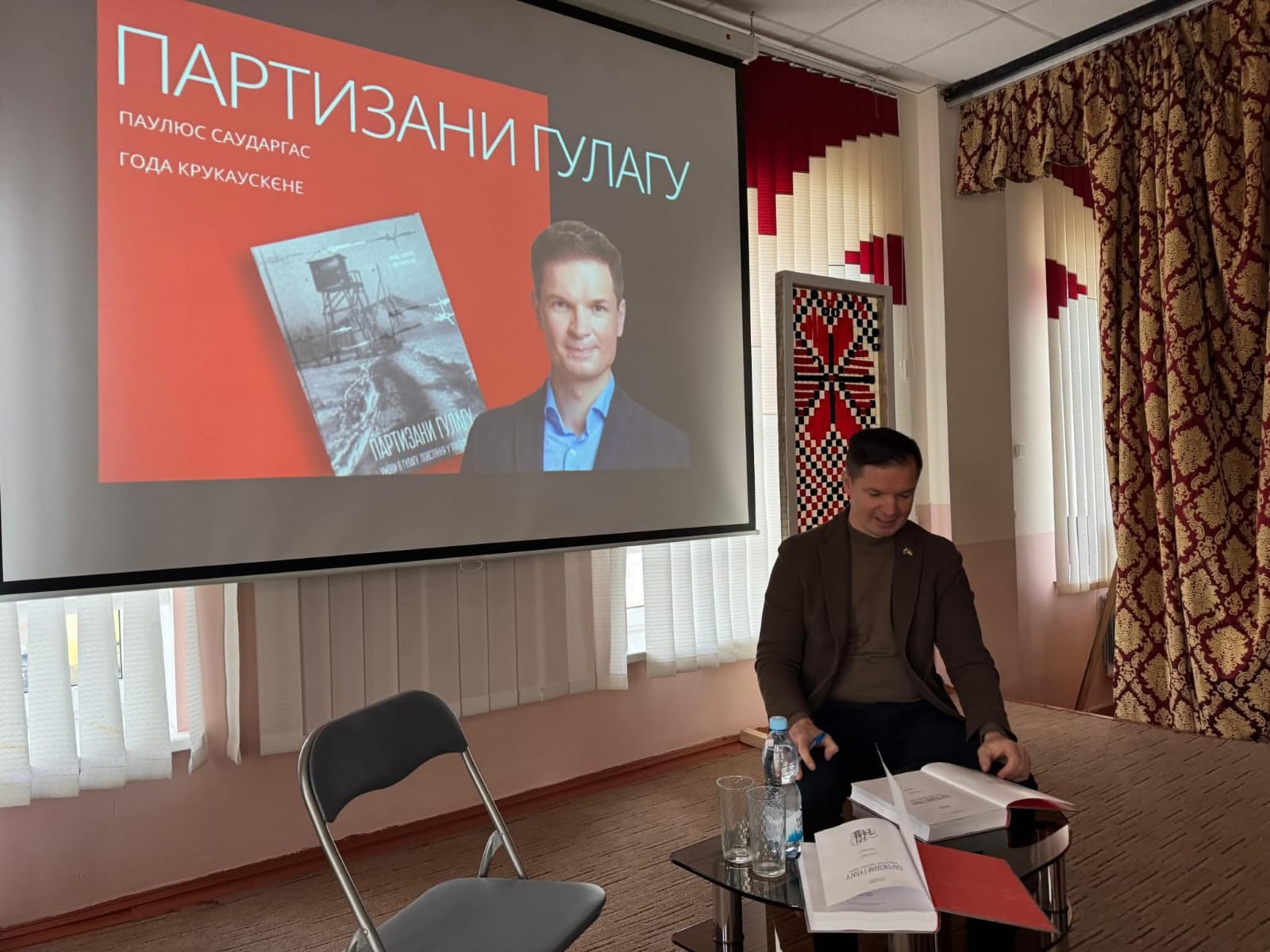








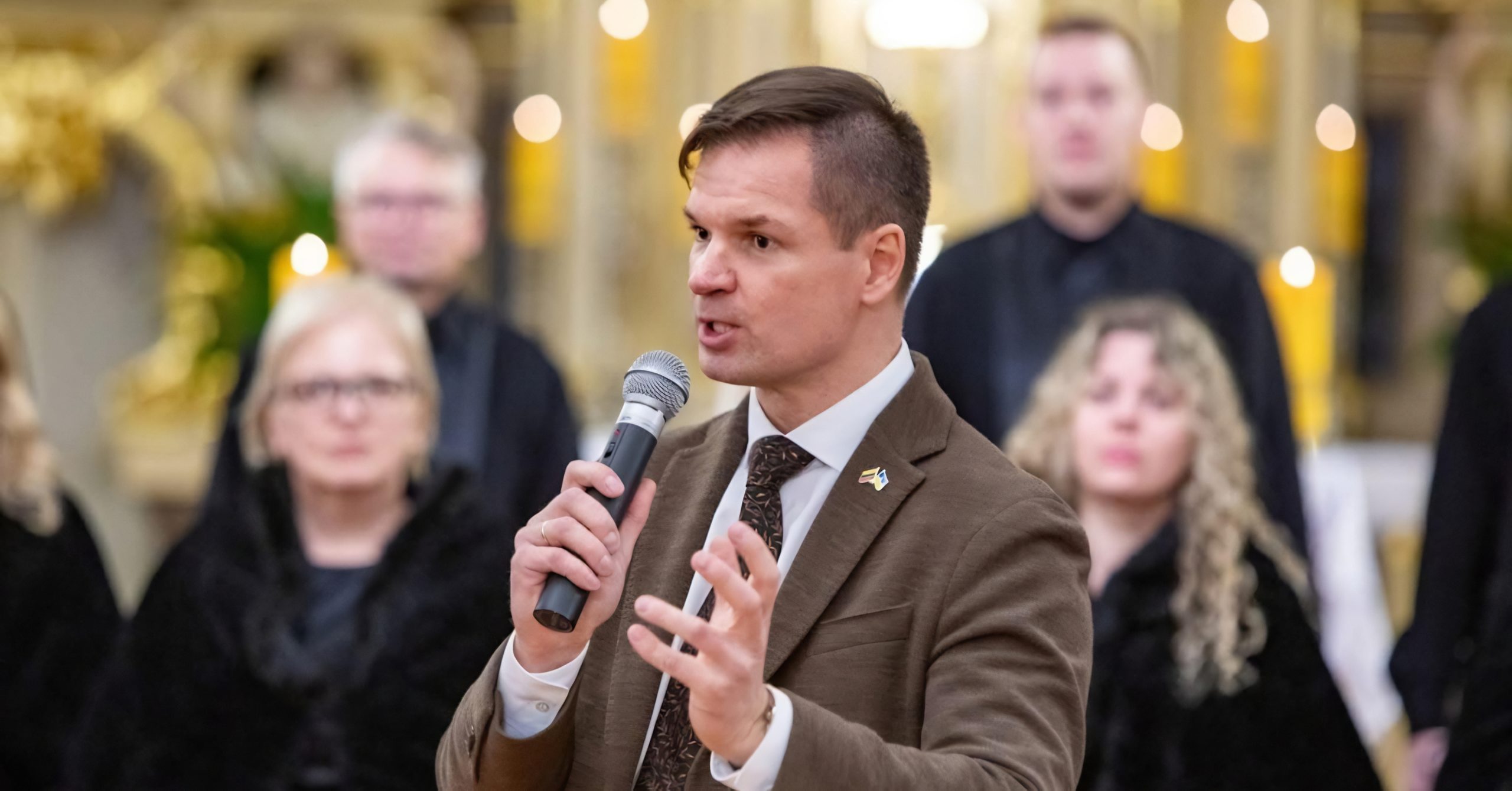
Paulius Saudargas a is a physicist and a Lithuanian politician. Member of the Seimas (Lithuanian Parliament) from 2008 to 2024 for the Homeland Union party, he was Deputy Speaker of the Seimas from 2020 to 2024, when he was elected for the European Parliament. The MEP has just returned from Ukraine, where he presented the Ukrainian edition of his book “Gulag Partisans”, which he co-authored with Goda Krukauskienė.
The book deals with the largest revolts in the Gulag camps, in Norilsk and Vorkuta in 1953, in Kengir in 1954, and again in Vorkuta in 1955. Were these revolts an exceptional event in the history of the Gulag?
Indeed, throughout the history of the GULAG, there were various manifestations of resistance or disobedience to the regime – ranging from escapes by political prisoners to small strikes. Yet until Stalin’s death, any unrest was suppressed swiftly, systematically, and without hesitation.
In 1953, after Stalin’s death, the enslaved population began to anticipate some form of change. When none materialised, a large-scale, well-organised strike-uprising erupted in Norilsk. It involved tens of thousands of political prisoners spread across several separate camps. Similar events later unfolded in Vorkuta, and subsequently in Kengir.
There were some pre-conditions to these uprisings: Stalin’s death and the expectations it created, the extremely harsh living conditions in the special-regime camps, and specific incidents with guards that acted as immediate triggers. Those camps were dominated mostly by political prisoners, and they were organized at that time. They formed underground network of resistance.
What were the prisoners’ conditions like? Why were the Lithuanians and Ukrainians the ones leading the resistance?
Conditions in the special camps were particularly harsh.
First, these camps were defined by extremely hard and often dangerous physical labour – such as work in coal mines – which severely damaged the health of prisoners. Food rations were wholly inadequate for people performing such exhausting work.
The guards were exceptionally strict. For example, during marches to and from work, armed guards would fire warning shots at any prisoner who stepped out of line. Many camps were located in regions with unbearable climatic conditions for human life, such as those beyond the Arctic Circle.
Ukrainians and Lithuanians statistically constituted the largest groups in these camps. In the special camps of the 1940s, political prisoners from Ukraine and the Baltic states accounted for around 40 percent of all inmates. This reflects the Soviet authorities’ view of these nations as the greatest “enemies of the people” -people they feared and sought to destroy. After all, Lithuania and Ukraine had mounted the largest organised armed resistance to the Soviet occupation for nearly a decade: the partisan war.
Those political prisoners who survived interrogation and were considered especially dangerous were the ones most often sent to the special camps.
It is hardly surprising that those who had resisted the Soviets most fiercely in their own countries – partisans, their supporters, and members of underground organisations – were also the most determined and best organised within the camps.
How did the Soviet authorities deal with the revolt? What happened to the “partisans”?
The most interesting thing is that this time, apparently because the resistance very suddenly gained a large scale (because it was well organized), the guards were unable or did not dare to immediately suppress it by force. The prisoners went on strike and demanded better conditions, and high-ranking negotiators were sent from Moscow to talk to them (for example, the Prosecutor General or Beria’s advisor). In some camps, it was possible to do without bloodshed and, after the negotiators agreed, they dispersed peacefully, but in some camps, reinforcements from the internal troops were sent and the rebels were attacked using automatic weapons, machine guns, and in Kengir – even tanks. Many participants in the uprising were killed.
When evaluating the death statistics, it is clear that Ukrainians and Lithuanians were standing in the first lines of the uprising, since they died disproportionately. Other prisoners were arrested, isolated, some returned to work, others transferred to other camps or high-security prisons. However, later conditions in the GULAG began to ease, and this unrest had a significant impact on this.
I understand that a member of your family was sent to the Gulag. This was the fate suffered by many thousands of Lithuanians.
My father’s uncle was sent to Vorkuta, where he worked in a coal mine. My father, Algirdas Saudargas, and my godfather, Algirdas Patackas, published banned underground press. Godfather A. Patackas was arrested by the KGB and spent a year imprisoned and interrogated in the KGB interrogation isolator in Vilnius – yet he did not betray my father.
Around 150,000 Lithuanians were deported to exile places, and a similar number were imprisoned within the GULAG system. Approximately 20,000 were killed fighting the partisan war in the forests, out of around 50,000 Lithuanians that took part in the armed resistance.
Are younger generations aware of the past? Are there policies for the recovery of historical memory in Lithuania?
The legend of the patriots and the experience of exile form the main heroic narratives of Lithuania at the turn of the century. These themes are taught in schools, and numerous memorials and museums across the country are dedicated to them. Yet I believe that many young people still know too little about this history – and are not sufficiently interested in history in general.
Our book “The Prisoner’s Limit” was created after we realised that students often struggle to grasp what the GULAG truly was. The book therefore examines the GULAG from multiple perspectives, explains specific aspects through various academic disciplines, and is written in a way that is accessible and engaging for young readers.
Memory is very necessary, especially because seventy years later we see that nothing has changed in Russia.
Russia has not changed in its essence – from the Tsarist empire to the Bolshevik regime and now Putin’s Russia. Putin is a reincarnation of Stalin, and Putin’s Russia is a reincarnation of USSR. Democracy has never taken root there; the Russian nation cannot even imagine living in a democratic system and remain accustomed to authoritarian rule. At the same time, Moscow continually tries to rewrite our history, discredit our states, and undermine our statehood.
For this reason, it is crucial for us to cultivate patriotism – one grounded in historical memory and in the heroic narratives that shape our national identity.
Lithuania, like Poland, Latvia, and Estonia, is particularly affected by Russia’s hybrid warfare, as in the case of the arrival of immigrants from the Middle East via Belarus. What stage is Russia’s hybrid warfare against Lithuania at?
We have long faced constant hybrid threats. We must continuously counter the propaganda produced by Moscow-controlled media. For decades, we have been reducing the presence of Russian content on our screens, and after the full-scale invasion of Ukraine, we removed Russian television channels from our airwaves entirely.
The hybrid attack orchestrated by Lukashenko, using illegal migrants, was a complex challenge – but we managed it. Within a year, we built a physical barrier, and our border is now far better protected against this type of threat.
However, we now need a reliable drone wall. The war in Ukraine has clearly shown that drones are becoming increasingly important, and we cannot afford to be unprepared. Both Poland and Lithuania have already experienced incidents of drones entering and crashing within our airspace, which makes a multilayered, integrated detection and neutralisation system – the drone wall essential.
Coming back to the book, how has it been received in Ukraine?
Ukrainians have responded very positively to the book and to work on this topic in general. It is extremely important for them to feel the support of their European brothers who have shared the same historical experience. This is our common history of resistance against the same enemy – one that today takes on a renewed and powerful meaning. Even more – some Ukrainians expressed interest in having more books in Ukrainian language explaining the partisan war against the USSR in Lithuania.
What lessons can we learn from this account of struggle and suffering in the Gulag?
What the residents of Russian-occupied Ukrainian territories as well as Ukrainian soldiers taken prisoner are experiencing today is reminiscent of the NKVD era and Stalin’s GULAG. There is no humanity in the actions of brutal Kremlin’s horde.
One of history’s greatest mistakes is that the West has still not fully understood or acknowledged that Stalin and the USSR committed atrocities no less horrific than those of Hitler and the Nazis. According to various estimates, tens of millions may have perished in Stalin’s GULAG. These were grave crimes against humanity and against entire nations, and they cannot be overlooked.
Looking at Putin’s Russia today, we must harbour no illusions: they will not stop spreading violence and seizing foreign lands. They have never learned to live democratically or abide by international norms. The Russian population is overwhelmingly shaped by propaganda and indoctrinated to believe in the leader’s delusions and to support imperial ambitions – no less than in Hitler’s Germany or Stalin’s Soviet Union. This is the hallmark of a totalitarian state, with all its disastrous consequences.
Putin and his circle can continue steering the entire country down a path of aggression without restraint, as there is no internal force capable of opposing them.